Getting the Whole Self Back
TL;DR
- I let AI draw the entire illustrated world of my latest product, and the reason is not the one people expect. It is not that I cannot draw. It is that the industry spent years training me not to.
- I am a good illustrator. Somewhere along the way I became a product designer instead, one clean box inside a larger team, because that is how our industry decided to grow.
- AI is quietly dissolving those boxes. It hands you back the parts of yourself the org filed away, so one person can be the illustrator, the engineer and the product designer on the same afternoon.
- It also gives back something we lost along the way: permission to be playful for its own sake, the way the web felt when it was made in Flash.
- And it keeps you current. The people coming up are closer to today's styles than I am, and that is exactly right. AI is a good way to be guided there instead of quietly aging out of taste.
- What is left for you is curation, and that turns out to be the good part. When making is cheap, your hours go to choosing well and to the work you actually love, which for me is the thinking, the delight, and coaching soccer on Saturdays.
- The one thing it still cannot do is have the taste in the first place. That part is still the job, and I suspect it always will be.
Not long ago I spent an afternoon making illustrations. Dozens of them, a whole little world for a product I was building, a character for every sport and a mood for every season. At some point I sat back and realized I had not really drawn, for anything that mattered, in something like fifteen years. And I used to be the one who drew. Before it quietly stopped being part of my job, that was a thing I was good at.
The story everybody tells about AI and creative work is a story about loss. It takes the drawing from the illustrator, the words from the writer, the craft from all of us, and leaves a person typing into a box. I understand the fear and I am not going to wave it away, because for plenty of people it is real. But it is not the story I have lived. For me, and I think for a lot of people who got filed into a single role years ago, the machine did something closer to the opposite. It gave the fun parts back.
The box the industry built
Here is how it happened, and it happened so slowly you barely feel it. I can draw, I can design, I can build the thing and ship it. Early on that was normal, you were expected to do a bit of everything because the teams were small and the web was young. Then our industry got big and got organized, and being able to do many things stopped being an asset and started being a scheduling problem. A generalist is hard to slot into a team. A specialist is legible, you can hire one, staff one, put one in a box on an org chart. So the industry took people who could do five things and gently, persistently, asked them to do one.
I became a product designer. A good one, and I do not regret the craft I built there. But the wider set of things I could do, the illustration, the animation, the coding, it all got quietly filed away as not my lane, and after enough years you half forget you ever had it. I always thought this was a slightly stupid way to build people, taking someone shaped like an M and pressing them flat into an I, and I said so more than once, and it changed absolutely nothing. That was simply the deal. The team needed a slot filled, and you were the slot.
What Flash knew
Do you remember what the web felt like when it was made in Flash? It was messy and it was slow and half of it was, frankly, unusable. But oh, it was alive. Sites moved and played and surprised you, and a lot of them existed for no better reason than that somebody wanted to make something delightful and could. Then the web grew up. It got standardized and accessible and fast and genuinely much better, and somewhere in all that maturing it also got a little joyless, because delight for its own sake is a luxury a specialized team with a roadmap rarely gets to afford.
What AI hands back, more than any single skill, is that permission. When one person can be the illustrator and the engineer and the product designer again on the same afternoon, without a budget meeting and a staffing plan, you can be playful the way we all were back then. You can decide a boring admin console deserves a whole illustrated world and simply go and give it one. This very portfolio is a small piece of that same spirit, if you look at it closely. I built it to be a little bit of a delight, on purpose, because I finally can again.
I don't fight the kids
There is a trap waiting for anyone who talks like this, and it is the grumpy old craftsman who thinks the real skill died with his generation. I want no part of that. The people coming up are far closer to today's styles and today's trends than I will ever be again, and that is not a tragedy, it is exactly how it is supposed to work. It is the natural evolution of things, and I am not going to stand on a lawn shouting at a cloud about it.
So I use AI for that too, and without embarrassment. It is a wonderful way to stay current, to be guided toward where taste actually lives right now instead of where it lived when I first learned to hold a pen. I can bring the years of judgment, and let the model keep me honest about the present. That is not cheating. That is a fifty-year-old refusing to age out of his own field, and using the best tool anyone has ever handed him to do it.
Taste is the part that stays
None of this means the craft evaporated. The machine rendered my hundred illustrations, but it did not decide the product should feel like that, it did not choose the palette or the wink in each little character, and it certainly did not hold one style steady across a hundred screens so the whole thing reads as a single hand. Every one of those was a judgment, and judgment is the thing that did not get cheaper. Generation got cheap. Taste did not, and I have come to believe it never will.
There is a word for what the job becomes, and the word is curator. When making a thing is cheap, your value is no longer in laying down every mark yourself, it is in choosing, in knowing which of the twenty options is the right one and why, in throwing the other nineteen away without flinching and holding the through-line steady across all of it. That has always been the most valuable thing a designer does, we just used to bury it under hours of production before we ever got to it. Now the production is fast and the curation is the whole job, and here is the quiet gift hiding in that. It gives you your time back. You get to spend your hours on the part you actually love, which for me is the thinking and the delight and the shape of the thing, and, not for nothing, the ninety minutes on a real field with real kids.
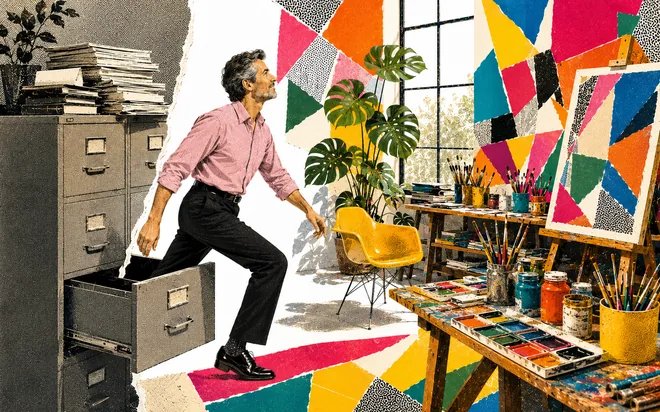
So no, I do not think AI took my craft. I think it walked into the room where the industry had been storing the parts of me I was not allowed to use at work, and it opened the drawer. I am an illustrator again, and an engineer, and a product designer, and I got to be all of them at once on a real product this year, which you can go and see for yourself. If you want the receipt for everything I have said here, it is a whole sports league I built alone: A League of One. Turns out the whole self was in there the entire time. It just needed something to open the box.